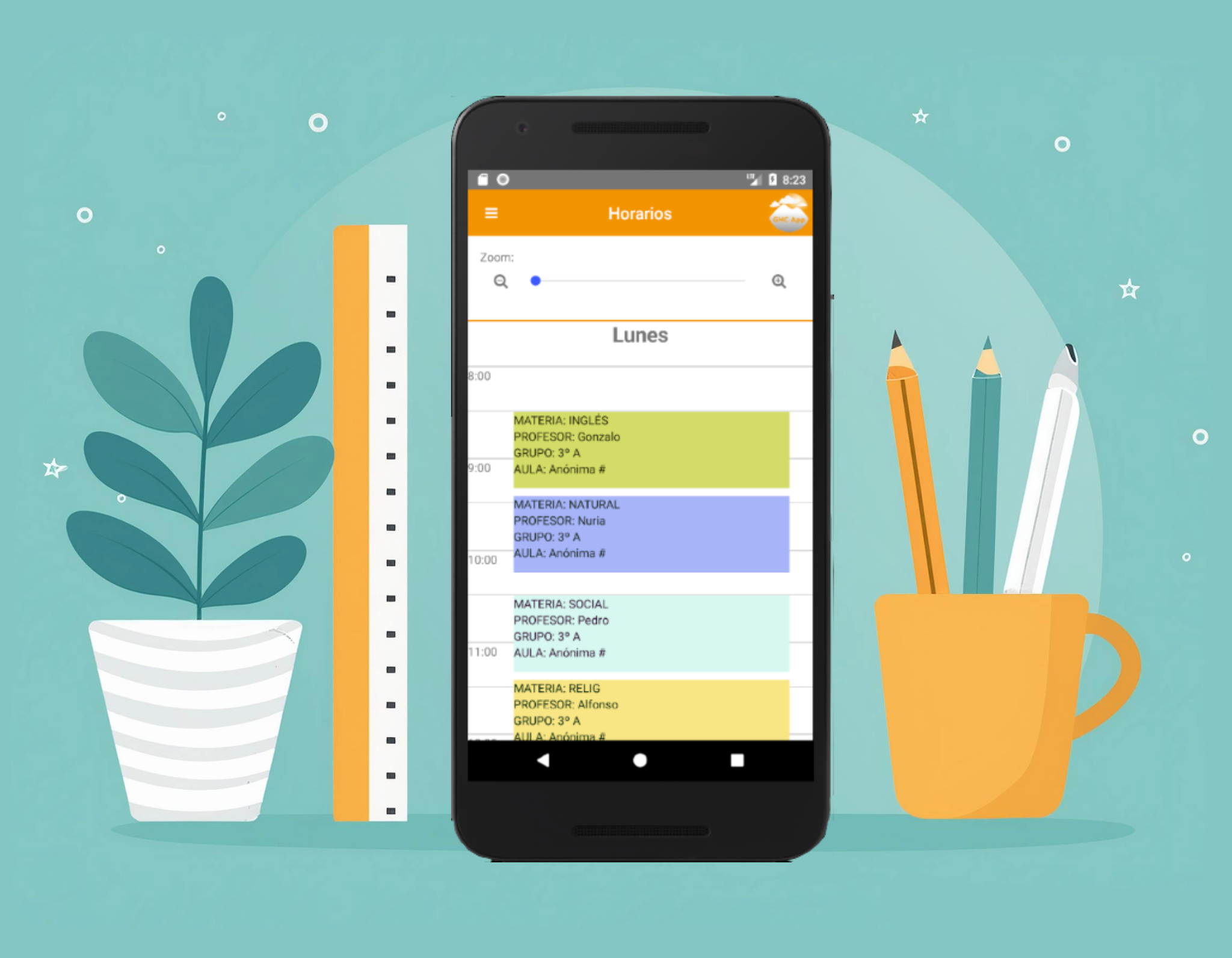
Automatically find weekly timetables for educational institutions of any type and complexity. Aimed at schools, secondary schools, baccalaureate, vocational training institutions, higher education, universities, colleges, art schools, music schools, etc.
We offer service to every user through quality software. Our team will accompany you until you get the solution for your timetable, with the experience of more than 25 years helping thousands of schools around the world.
Organise the timetable to meet your requirements and optimise it according to your criteria. Seek and find a compromise that will (1) increase student achievement, (2) improve classroom using, and (3) provide greater teacher job satisfaction.
Use our web and mobile app to collaborate in the preparation and day-to-day management of the timetable. Publish and view timetables on the calendar with the GHC App, manage teacher absences and substitutions and generate labor reports.
These systems can store over 200 bicycles in a footprint of just 57 square meters, using robotic arms to retrieve bikes in roughly 13 seconds.
Then alarms blared, and the basement doors began to seal.
The Bicycle Confinement Laboratory stands out for its ability to simulate a wide range of environmental conditions, from the blistering heat of a summer's day to the pouring rain of a stormy night. This controlled environment allows researchers to meticulously study the effects of weather on both the rider and the bicycle, without the unpredictability of outdoor conditions. The lab is equipped with sophisticated wind tunnels, capable of simulating wind speeds of up to 100 km/h, which enables scientists to analyze aerodynamic drag on cyclists and bicycles under precise conditions.
Traditional bicycle testing often occurs in open-air environments or wind tunnels focused solely on aerodynamics. In contrast, a confinement laboratory creates a environment.
Controlled experiments track microscopic trajectories to understand how cyclists perform "evading maneuvers" when they encounter others in narrow paths.
These systems can store over 200 bicycles in a footprint of just 57 square meters, using robotic arms to retrieve bikes in roughly 13 seconds.
Then alarms blared, and the basement doors began to seal.
The Bicycle Confinement Laboratory stands out for its ability to simulate a wide range of environmental conditions, from the blistering heat of a summer's day to the pouring rain of a stormy night. This controlled environment allows researchers to meticulously study the effects of weather on both the rider and the bicycle, without the unpredictability of outdoor conditions. The lab is equipped with sophisticated wind tunnels, capable of simulating wind speeds of up to 100 km/h, which enables scientists to analyze aerodynamic drag on cyclists and bicycles under precise conditions.
Traditional bicycle testing often occurs in open-air environments or wind tunnels focused solely on aerodynamics. In contrast, a confinement laboratory creates a environment.
Controlled experiments track microscopic trajectories to understand how cyclists perform "evading maneuvers" when they encounter others in narrow paths.
15267